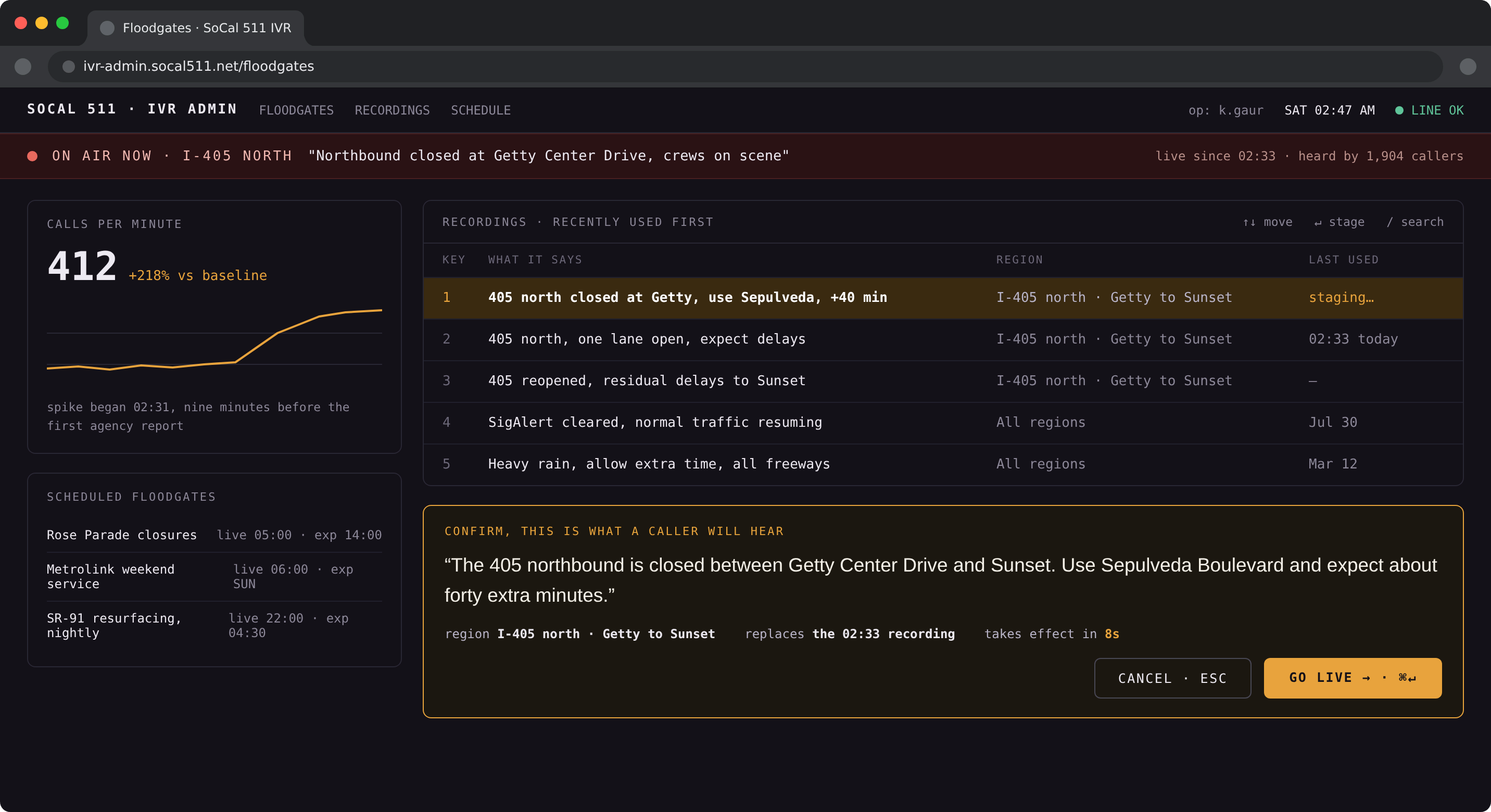
SoCal 511 IVR admin dashboard
511 is the phone line Southern California calls for traffic and transit information. Behind it sits an interactive voice response system, and behind that a dashboard where a handful of operators schedule floodgate messages, watch call volume, and cut over recordings during an incident.
The same few people use this tool every day, for years, and often during an emergency. That combination argues for density and keyboard access over friendliness, a professional instrument, not a consumer app.
What the tool actually does
Three jobs, all of them public the moment they happen. Operators schedule floodgate messages ahead of planned closures, the announcement every caller hears before any menu. They watch live call volume, because a spike is often the first sign that something has gone wrong on the network before any agency has reported it. And they cut over recordings when the situation changes, swapping what a region hears in real time.
There is no draft mode on a phone line. Whatever this dashboard says is what a caller on the 405 hears. That is the design constraint that matters more than any other: the interface has to make the current state of the system unmistakable, because its users are editing production, live, by hand.
Design for the worst hour
I designed the incident state first and the calm state second. During a closure, call volume spikes and the operator has one job: get the right recording live. That path is now a few keystrokes with a visible confirmation of what callers will hear, including the exact seconds until it takes effect.
The calm-day interface and the incident interface are the same interface. Nothing rearranges itself under pressure, nothing has to be relearned at the worst possible moment, the emergency path is simply the everyday path, done faster. Recently used recordings surface first, and every scheduled message shows exactly when it goes live and when it expires.
Nothing goes live without a preview. The confirmation step plays back what callers will hear, the recording, the region it covers, the moment it takes effect, because the cost of a wrong cutover is a freeway full of people acting on wrong information.
Keyboard first, mouse never
The rest is a dense table with a real focus ring, because these operators never touch the mouse. Every row action has a key, the focus state is visible from across a control room, and recordings carry plain-language names, what it says, not what the file is called. Density here is not an aesthetic; it is how you keep the whole system’s state on one screen while you are on the phone with a highway patrol dispatcher.